
Cold Storage Inventory Management System: The Complete Guide for Food Industry Operations
Cold Storage Inventory Management System: The Complete Guide for Food Industry Operations
 admin
admin
Imagine discovering that ₹20 lakh worth of frozen inventory is no longer sellable—not because it expired, but because a freezer door was left open for three hours overnight.
For food businesses, inventory loss isn’t usually caused by lack of stock. It’s caused by lack of visibility.
The food industry operates under conditions that most warehouses never face:
- Products expire
- Temperature deviations destroy inventory
- Regulatory audits demand traceability
- Energy costs continue rising
- Customers expect freshness
Yet many businesses still manage cold storage operations using spreadsheets, manual logs, and disconnected systems.
This is where a Cold Storage Inventory Management System becomes essential—not merely for tracking stock, but for managing shelf life, temperature integrity, compliance, and profitability at the same time.
In this guide, you’ll learn:
- Why traditional inventory systems fail in cold storage environments
- Critical features of modern cold storage inventory systems
- Hidden causes of spoilage and inventory losses
- How FEFO inventory management reduces waste
- KPIs that industry leaders track
- Future trends shaping cold chain operations
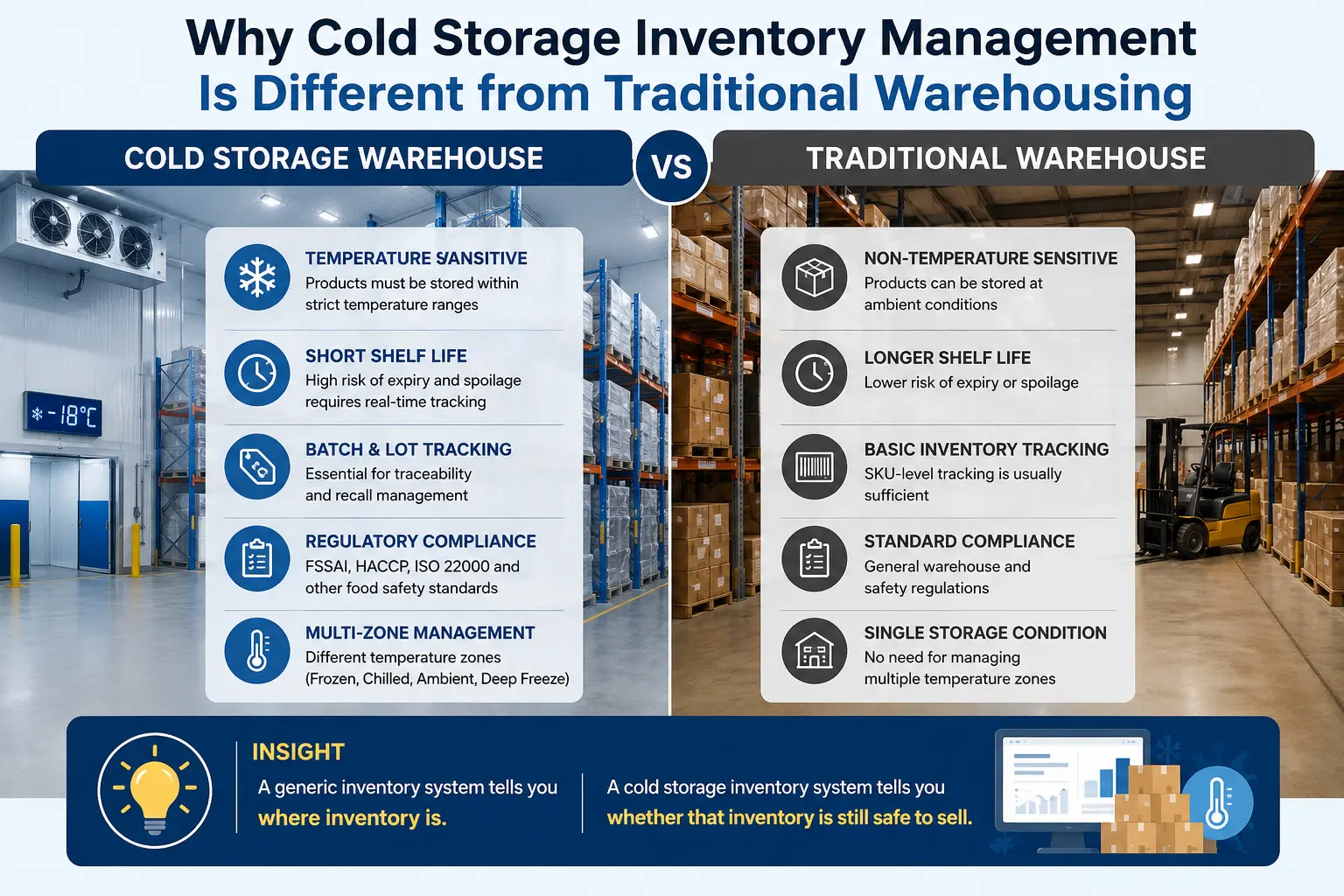
Why Cold Storage Inventory Management Is Different from Traditional Warehousing
The Unique Challenges of Food Industry Inventory
A standard warehouse stores goods. A cold storage facility keeps them alive.
That distinction changes everything. Here are the core challenges that separate cold chain operations from conventional warehousing:
Limited shelf life. Every product has an expiry date. Delays, poor rotation, and visibility gaps turn sellable inventory into write-offs.
Temperature-sensitive products. A two-degree deviation from the required storage temperature can silently compromise an entire pallet—without any visible sign of damage.
Regulatory compliance requirements. FSSAI, HACCP, and ISO 22000 place strict demands on traceability, documentation, and temperature records. Failing an audit isn’t just a fine—it can shut down operations.
Product recalls. When a contamination event occurs, you need to trace every affected batch within hours—not days. Manual systems simply cannot do this at scale.
Multiple temperature zones. Frozen goods, chilled dairy, ambient produce, and deep-freeze proteins can all sit within the same facility, each requiring different conditions and handling protocols.
The True Cost of Poor Inventory Visibility
When cold storage operations lack real-time visibility, the losses go beyond spoiled goods.
- Product spoilage from expired stock that wasn’t prioritized for dispatch
- Overstocking driven by inaccurate stock counts, leading to excess purchasing
- Stockouts caused by poor demand forecasting tied to unreliable inventory data
- Compliance penalties from incomplete traceability records during regulatory audits
- Customer dissatisfaction from orders fulfilled with near-expiry products
Each of these is preventable. Each is also measurable—when you have the right system in place.
Why Standard ERP Inventory Modules Often Fall Short
Most ERP platforms are built for general inventory management. They track quantities, locations, and movements. But they were not designed with cold chain operations in mind.
Common shortcomings include:
- No native temperature tracking or excursion alerts
- No expiry-date prioritization for picking
- Limited lot and batch traceability
- Weak integration with cold chain monitoring hardware
Insight: A generic inventory system tells you where inventory is. A cold storage inventory management system tells you whether that inventory is still safe to sell.
What Is a Cold Storage Inventory Management System?
A Cold Storage Inventory Management System is a purpose-built software platform designed to manage all aspects of food and perishable inventory across temperature-controlled facilities.
It combines:
- Inventory management — real-time stock tracking, quantity management, and location mapping
- Warehouse management — receiving, putaway, picking, packing, and dispatch workflows
- Temperature monitoring — integration with IoT sensors to capture and log storage conditions
- Compliance tracking — automated audit trails, regulatory reports, and traceability documentation
- Lot and batch management — granular tracking from supplier to customer
Core Components
| Component | Function |
| Inventory Database | Central repository for all product, location, and batch data |
| WMS Module | Controls warehouse workflows from inbound to outbound |
| IoT Sensors | Capture real-time temperature and humidity data |
| Barcode/RFID Systems | Enable accurate, automated stock identification and movement tracking |
| Reporting & Analytics | Dashboards, KPI tracking, and compliance reporting |
How It Fits Into the Food Supply Chain
A cold storage inventory management system sits at the heart of the food supply chain:
Supplier → Receiving → Cold Storage → Picking → Dispatch → Retail
At each stage, the system captures critical data: batch numbers, expiry dates, temperature readings, storage location, and movement timestamps. This creates an unbroken chain of traceability from source to shelf.
The 10 Must-Have Features of a Modern Cold Storage Inventory Management System
1. Real-Time Inventory Visibility
You cannot manage what you cannot see.
Real-time inventory visibility means knowing—at any given moment—what stock is available, where it is located, and what condition it is in. This includes:
- Live stock counts across all SKUs and locations
- Zone-level and bay-level location tracking
- Multi-warehouse visibility from a single dashboard
This is the baseline requirement. Every other feature depends on it.
2. FEFO (First Expired First Out) Automation
FEFO is not optional for food businesses. It is the only rotation method that actively protects against spoilage.
FEFO (First Expired First Out) means products closest to their expiry date are picked and dispatched first—regardless of when they arrived. This is fundamentally different from FIFO (First In First Out), which prioritizes arrival order.
Hidden Insight: Many companies still operate FIFO while believing they are running FEFO. True FEFO requires system-driven expiry-based allocation, not manual judgment. Pickers following manual instructions cannot reliably execute FEFO at scale.
Automated FEFO means:
- The system assigns picking priorities based on expiry dates
- Near-expiry stock gets flagged and allocated before fresher stock
- No reliance on human memory or manual checks
3. Batch & Lot Tracking
When a recall happens, you need to answer one question within hours: Which customers received stock from this batch?
Batch and lot tracking makes that possible. Every unit in your facility is linked to a specific production run, supplier, and date. The system logs every movement—receipt, storage, transfer, and dispatch—at the batch level.
Benefits include:
- Rapid recall isolation without disrupting other inventory
- Complete audit trails for regulatory inspections
- Traceability data that builds customer confidence
4. Expiry Date Monitoring
Expiry date monitoring goes beyond simply recording dates in a database. A proper system:
- Sends automated alerts when products cross a defined shelf-life threshold (e.g., 30% of shelf life remaining)
- Displays shelf-life dashboards by zone, category, or SKU
- Flags “at-risk” stock for accelerated dispatch or promotional action
This converts expiry management from a reactive cleanup task into a proactive commercial decision.
5. Temperature & Humidity Monitoring
IoT-connected temperature sensors are no longer optional in food cold storage—they are a compliance requirement in most regulated markets.
A cold storage inventory management system should integrate directly with your sensor hardware to:
- Log temperature and humidity readings at defined intervals
- Trigger automated alerts when readings fall outside acceptable ranges
- Maintain a complete excursion log for compliance documentation
- Link temperature events directly to the inventory stored in the affected zone
If a freezer malfunctions overnight, you should know exactly which pallets were exposed, for how long, and whether the deviation crosses a compliance threshold.
6. Multi-Zone Storage Management
A single cold storage facility typically operates across multiple temperature zones:
| Zone | Temperature Range | Typical Products |
| Ambient | 15°C – 25°C | Dry goods, spices |
| Chilled | 0°C – 5°C | Dairy, fresh produce |
| Frozen | -18°C to -22°C | Meat, seafood, frozen meals |
| Deep Freeze | Below -25°C | Long-term frozen storage |
A purpose-built system manages each zone independently, with zone-specific alerts, compliance rules, and inventory assignments.
7. Barcode & RFID Tracking
Manual data entry is the primary source of inventory errors. Barcode and RFID tracking eliminate manual entry at the point of movement.
- Barcodes work well for most cold storage environments and are cost-effective
- RFID enables bulk scanning without line-of-sight, making it suitable for high-volume operations
Both approaches generate real-time movement records that feed directly into the inventory database, ensuring stock counts are accurate from the moment goods arrive.
8. Compliance Management
Food businesses in India operate under FSSAI requirements. Many also hold HACCP or ISO 22000 certifications. A cold storage inventory management system should:
- Maintain automated audit trails for all stock movements and temperature events
- Generate FSSAI-compliant traceability reports on demand
- Store documentation required for HACCP verification activities
- Support ISO 22000 corrective action workflows
Compliance should be a byproduct of normal operations—not a manual reporting exercise triggered by an upcoming audit.
9. Automated Replenishment
Stock levels in cold storage require careful management. Overstocking leads to expiry losses. Understocking leads to missed orders.
Automated replenishment rules—set against minimum stock levels, order lead times, and demand patterns—trigger purchase orders or production requests before stockouts occur. When combined with expiry monitoring, the system can also slow replenishment for near-expiry items, avoiding further accumulation.
10. Analytics & KPI Dashboards
What gets measured gets managed.
A strong analytics module surfaces the metrics that matter most in cold chain operations: spoilage rates, FEFO compliance, temperature compliance, inventory turnover, and energy consumption per pallet. These dashboards give operations teams and management a shared picture of facility health—not just inventory value.
Expert Insight: Most facilities monitor inventory value. Very few monitor inventory health. Inventory health combines remaining shelf life, storage condition, and demand probability. This is becoming a key KPI in advanced cold chain operations.
The Hidden Inventory Problems Most Cold Storage Facilities Don’t Measure
This is where most cold storage operations leave money on the table—and most software vendors don’t talk about it.
Temperature Excursion Cost
A product may show as “available” in your inventory system. But if that product experienced a temperature excursion for several hours, it may already be commercially compromised—even if it hasn’t reached its printed expiry date.
Without a system that links temperature events to specific stock, these items remain in inventory as usable stock until someone notices, or worse, until a customer complains.
Door Open Time Losses
Advanced cold storage facilities now monitor:
- How long loading dock doors remain open during each shift
- Loading bay exposure times for pallets awaiting dispatch
- Dock delay patterns that increase refrigeration demand
Even a 10-minute extension in average door-open time per shift can increase energy consumption significantly across a year of operations.
“Zombie Inventory”
Zombie inventory is stock that:
- Technically exists in the system
- Is approaching its expiry date
- Has low or zero probability of being sold before it expires
Yet it remains counted as usable, sellable stock—inflating apparent inventory value and masking the true spoilage exposure.
Advanced cold storage inventory management systems flag zombie inventory automatically, so operations teams can take action: markdown pricing, donation, or planned write-off.
Inventory Aging Blind Spots
Some products move through the warehouse regularly but never reach the customer in meaningful quantities. They get received, stored, moved, and re-stored—but not dispatched.
Without aging reports tied to demand data, these blind spots accumulate silently until they become large-scale spoilage events.
Energy Cost Per Pallet
One of the least discussed metrics in cold chain management. Leading facilities track:
- Energy consumed per pallet stored per month
- Energy consumed per order shipped
This metric connects operational decisions (door management, loading schedules, zone utilization) directly to cost. Facilities that track it consistently find meaningful opportunities for reduction.
How FEFO Inventory Management Reduces Food Waste by Up to 40%
FEFO vs FIFO
| Feature | FEFO | FIFO |
| Basis for rotation | Expiry date | Arrival date |
| Waste reduction | Strong — dispatches near-expiry stock first | Moderate — may leave near-expiry stock untouched |
| Compliance suitability | High — aligned with food safety requirements | Limited — no expiry-based prioritization |
| System requirement | Requires expiry capture at receiving | Works with date-of-receipt records only |
| Manual execution risk | High — requires system automation to be reliable | Lower — arrival order is easier to track manually |
Real-World Example
Consider a frozen food warehouse receiving the same product SKU across three separate shipments:
- Shipment A: Arrived January 1, expires March 31
- Shipment B: Arrived January 15, expires April 15
- Shipment C: Arrived January 20, expires May 1
A FIFO system dispatches Shipment A first—which happens to be correct in this case. But if Shipment B arrived with a shorter shelf life than Shipment A (which frequently happens with rolling production runs), FIFO would dispatch the longer-dated stock first—leaving the near-expiry product to accumulate.
FEFO eliminates this risk entirely by making expiry date—not arrival date—the dispatch priority.
Implementation Best Practices
- Capture expiry dates at receiving. Every inbound unit must have its expiry date recorded before putaway. Barcode scanning linked to the inventory system makes this automatic.
- Track at batch level. FEFO only works when the system can distinguish between batches of the same SKU with different expiry dates.
- Automate picking instructions. The warehouse management system should generate pick lists sorted by expiry date—removing the need for manual judgment.
- Set proactive expiry alerts. Flag stock approaching a threshold (e.g., 60 days to expiry) so commercial teams can take action before it becomes a loss.
Food Safety Compliance and Traceability Requirements
Why Regulators Demand Traceability
Food safety incidents don’t just harm consumers—they expose businesses to recalls, litigation, and reputational damage. Regulators require traceability because it enables rapid containment when problems occur.
The ability to trace a product from farm to fork—and to identify all affected batches within hours—is now a baseline expectation for any food business operating at scale.
FSSAI Requirements
The Food Safety and Standards Authority of India (FSSAI) mandates that food businesses maintain records covering:
- Supplier details and purchase records
- Batch and lot information for all processed goods
- Storage conditions and temperature logs
- Distribution records enabling downstream traceability
FSSAI inspections can occur with short notice. Manual records are difficult to search, easy to lose, and frequently incomplete.
HACCP Expectations
Hazard Analysis and Critical Control Point (HACCP) systems require documented monitoring of critical control points—most of which in cold storage involve temperature. A cold storage inventory management system that logs temperature data automatically and links it to stored inventory satisfies core HACCP monitoring requirements.
Audit Trail Requirements
A complete audit trail documents every event in an inventory item’s lifecycle: receipt, putaway, transfer, temperature exposure, picking, and dispatch. This trail must be tamper-evident and searchable by date, batch, product, and location.
Paper logs and spreadsheets cannot meet this requirement reliably.
How Inventory Systems Simplify Compliance
- Batch history is captured automatically at every movement
- Temperature logs are stored against specific storage zones and time windows
- Recall reporting can produce a complete distribution list for any batch within minutes
Compliance becomes an output of daily operations—not a separate documentation burden.
Cold Storage KPIs Every Food Business Should Track
| KPI | What It Measures | Target Range |
| Inventory Accuracy % | How closely system records match physical stock | >99% |
| Spoilage Rate % | Value of stock written off as a percentage of total inventory value | <1% |
| FEFO Compliance % | Percentage of picks executed in correct expiry order | >98% |
| Temperature Compliance % | Percentage of time storage zones remain within acceptable range | >99.5% |
| Inventory Turnover | How often total inventory is sold and replaced | Category-dependent |
| Dock-to-Stock Time | Time from receiving to putaway completion | <2 hours |
| Order Accuracy % | Percentage of orders fulfilled without errors | >99.5% |
| Energy Cost Per Pallet | Total energy spend divided by average pallets stored | Benchmark against prior periods |
Expert Insight: Most facilities monitor inventory value. Very few monitor inventory health—the combination of remaining shelf life, storage condition, and demand probability. This is becoming a defining KPI in advanced cold chain operations.
Emerging Technologies Transforming Cold Storage Inventory Management
IoT Sensors
The next generation of IoT sensors goes beyond temperature and humidity. Facilities are now deploying sensors that monitor door open/close events, pallet movement, energy draw by zone, and CO₂ levels. All of this data feeds into the inventory management system to give a complete picture of facility health.
AI-Powered Demand Forecasting
Artificial intelligence can analyze historical sales data, seasonal patterns, and supplier lead times to generate more accurate demand forecasts. When integrated with cold storage inventory management, this prevents both overstocking (and the spoilage risk it creates) and stockouts.
Predictive Spoilage Detection
Machine learning models trained on temperature history, product type, and remaining shelf life can now predict spoilage risk before it becomes visible. This lets operations teams take action—accelerating dispatch, adjusting storage conditions—before product is lost.
Digital Twins for Cold Warehouses
A digital twin is a real-time virtual replica of the physical facility. Cold storage operators are using digital twins to simulate the impact of layout changes, new product introductions, and equipment failures before they occur in the real world.
RFID-Enabled Inventory Tracking
RFID is moving from pilot projects to mainstream deployment in cold storage. Smart tags that survive sub-zero temperatures now enable automated inventory counts without manual scanning—reducing labor costs and improving accuracy simultaneously.
Autonomous Cold Storage Robotics
Automated storage and retrieval systems (AS/RS) are entering cold storage facilities, handling putaway and picking in environments too cold for efficient human operation. These systems integrate directly with cold storage inventory management platforms to receive and execute instructions.
Machine Learning for Energy Optimization
Energy represents a significant operating cost in cold storage. ML models that optimize compressor cycles, door-open schedules, and zone temperatures based on actual load patterns are delivering meaningful reductions in energy spend.
Advanced Insight: Future systems won’t simply tell you: “This pallet exists.” They will tell you: “This pallet has a 72% chance of becoming unsellable within 10 days.” Research is already moving toward integrating inventory decisions with quality, temperature, humidity, and storage conditions simultaneously.
How to Choose the Right Cold Storage Inventory Management System
Questions to Ask Vendors
Before committing to any platform, ask these questions directly:
- Does the system support FEFO—and is it automated or manual?
- Can it integrate with our existing ERP or accounting software?
- Does it support IoT temperature sensor integration?
- Can it manage multiple temperature zones independently?
- Does it generate compliance reports for FSSAI and HACCP audits?
- How does it handle product recalls—and how quickly can a full batch trace be completed?
- What does implementation look like, and what support is provided?
Red Flags to Watch For
| Red Flag | What It Signals |
| Relies on spreadsheet exports for any core function | Limited system capability |
| Expiry tracking is manual or requires workarounds | FEFO cannot be reliably automated |
| No native temperature sensor integration | Cold chain monitoring must be handled separately |
| No batch-level audit trail | Compliance and recall management will be manual |
| No multi-zone support | System was not built for cold storage |
Evaluation Checklist
Use this checklist when evaluating vendors:
- [ ] Real-time inventory visibility across all zones and locations
- [ ] Automated FEFO picking logic based on expiry dates
- [ ] Batch and lot tracking from receiving through dispatch
- [ ] Expiry date alerts with configurable thresholds
- [ ] IoT sensor integration for temperature and humidity
- [ ] Multi-zone temperature management
- [ ] Barcode and/or RFID scanning support
- [ ] FSSAI/HACCP compliance reporting
- [ ] Automated replenishment rules
- [ ] KPI dashboards including spoilage rate and energy per pallet
- [ ] ERP and accounting integration
- [ ] Cloud-based access for multi-site visibility
- [ ] Recall management with full batch distribution trace
Conclusion
A modern Cold Storage Inventory Management System is no longer just a warehouse tool.
It has become the operational control tower for food businesses—managing inventory accuracy, food safety, regulatory compliance, spoilage prevention, and operational efficiency from a single platform.
The most successful food companies aren’t merely tracking stock. They’re tracking shelf life, temperature integrity, inventory health, energy consumption, and traceability—simultaneously, in real time.
If your operation still relies on spreadsheets, manual temperature logs, or disconnected inventory processes, the time to change that is now.
The question is no longer: “Can we afford to implement a cold storage inventory management system?”
The real question is: “How much spoilage, waste, and operational risk are we absorbing by not having one?”
Ready to evaluate a purpose-built cold storage inventory management system for your operation? Start with the evaluation checklist above and ask every vendor the questions that matter most for food safety, FEFO compliance, and cold chain visibility.
Alternatively, you can also follow us on LinkedIn, or YouTube, for interesting updates on digital transformation for your business.